
Quality control · Training · Quality system
Build quality before you inspect it From the workshop to the display case
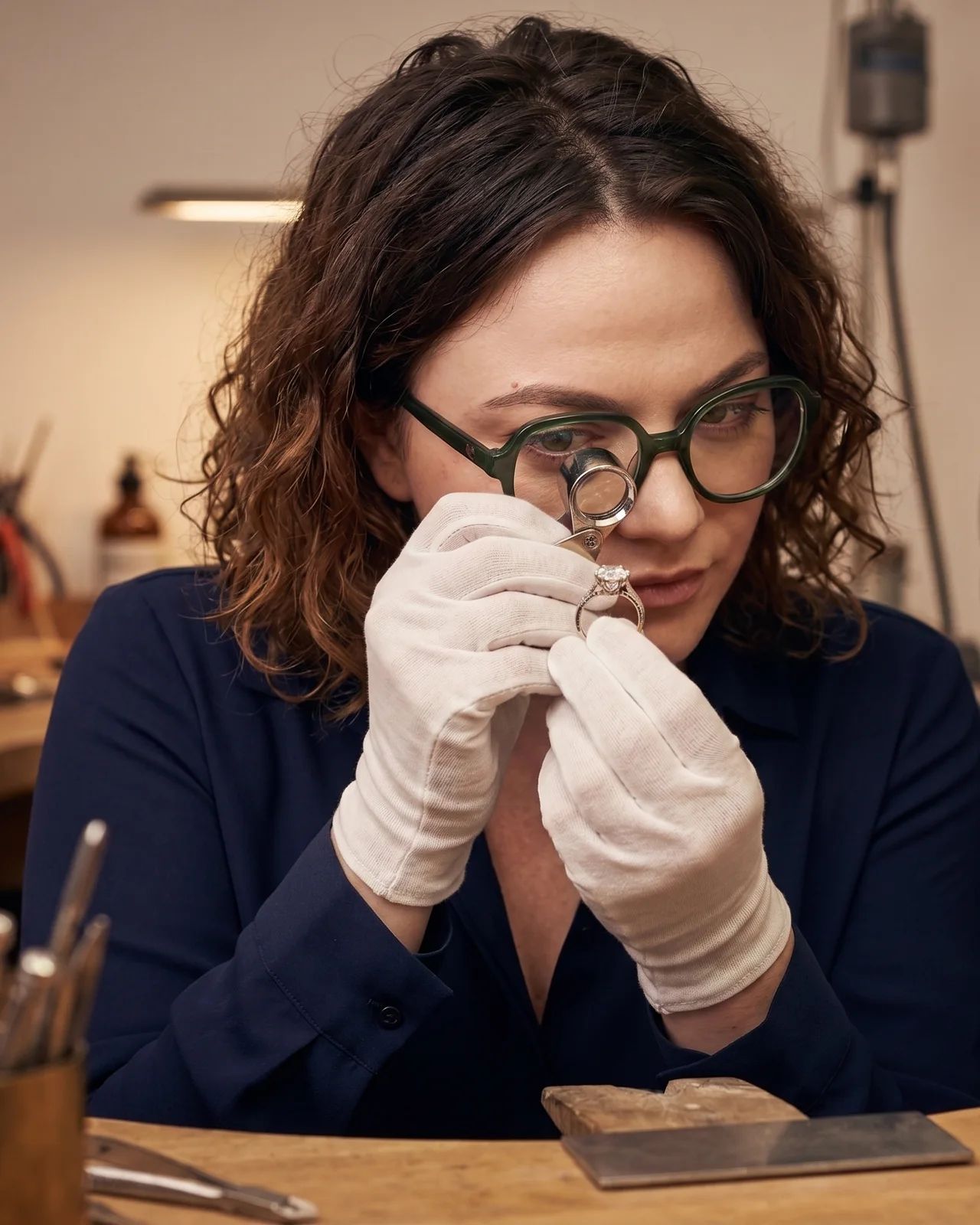
Maude Druoton, gemmologist and jewellery quality consultant. I work in the workshop, on finished pieces, prototypes and pre-series, in France and across Europe.
Three areas of expertise, one standard
A single craft, quality

A method designed for jewellery
My method rests on five Foundations, always laid in the same order.
-
 Foundation 1
 Reading
Assess the situation on the floor, before writing a single line.
-
 Foundation 2
 Standards
Set written criteria and a visual reference guide.
-
 Foundation 3
 Steering
Track a few useful indicators every week.
-
 Foundation 4
 Documented savoir-faire
Capture the craft without freezing it.
-
 Foundation 5
 Workshop-to-management dialogue
Set up a regular exchange, pieces in hand.
Where I work
I inspect pieces for maisons on the Place Vendôme, independent or part of large groups, as regular or one-off support. I also spent several months in a European manufacture, building its quality system with its teams. I left behind a visual reference guide, a shared language for defects and trained inspectors.
What a gemmologist changes at inspection
On a mounted piece, the stone is the part a standard inspection reads least well. It is checked for security. What it is, and what it has been through, is rarely looked at. A chip on the girdle, a colour that does not match the lot, a break after a repair. These are the costliest defects and the least often seen.
As a gemmologist, I inspect the stone and the metal in a single pass, and the piece leaves with its decision the same day.
What the workshop receives the same evening
A day of inspection does not end when the last piece is put down. In the evening, the workshop receives the day’s points of vigilance, illustrated. The piece, the defect, the criterion applied, the decision. One page to pin up at the bench, which keeps the same defect from coming back the following week.
A non-conformity report coded for the maison, an illustrated vigilance email for the workshop: the decision on one side, the improvement on the other. That is what separates expert inspection from a pair of hands passing through. Temporary support leaves with what it has seen. Expert inspection leaves it with the workshop.
One person throughout, from the first inspection to the final report. Your teams keep the knowledge, never the dependency.
-
The approach
Every piece is analysed against a written criterion. When the criterion does not exist, it is written, agreed with the workshop and kept.
-
The deliverables
Daily report, borderline cases photographed, non-conformities described with a likely origin and a recommendation.
-
The extensions
Incoming supplier inspection, formal feedback to the supplier, pre-series validated on site.
-
Mobility
Greater Paris, all of France, Germany, Italy, Switzerland.
Beyond inspection
Piece-by-piece inspection often brings wider issues to light, such as a criterion everyone applies but no one has yet written down, or a decision that depends on who happens to be there that day. I also build the quality system, with the teams, up to ISO 9001 when certification is the aim. Some organisations come to it after an inspection assignment, others start there directly.
Let’s build your quality
A diagnostic to photograph your workshop, identify the priorities and lay the foundations of your quality system. Twenty-five questions, about ten minutes, a personal reading within forty-eight working hours.
Request a diagnosticContact
Let’s talk.
A quality control need, a training programme, a quality system project, or simply a question. Tell me where you stand and I will reply within two working days.